Number of Parts per Tree
The number of parts per (or, equivalently, the number of wax patterns per tree) is the product of the number of Number of Patterns per Layer and Number of Tree Layers. See the following sections:
-
Panel Tree: Number of Wax Patterns Along the Depth Dimension
-
Panel Tree: Number of Wax Patterns Along the Width Dimension
Panel Tree: Number of Wax Patterns Along the Depth Dimension
Panel Tree: Number of Wax Patterns Along the Width Dimension
By default, the number of wax patterns along the width dimension of a panel tree is the maximum number of wax patterns that can fit across the tank for the current Primary Slurry Dipping machine (see Primary Slurry Dipping Machine Selection), given the constraints and assumptions described in Panel Tree: Bounding Box Width. Users can, in effect, override the default with the setup option Number of Wax Patterns per Layer.
Number of Patterns per Layer
By default, for a panel tree, the number of patterns per layer is the product of the following:
-
Number of wax patterns along the depth dimension (see Panel Tree: Number of Wax Patterns Along the Depth Dimension)
-
Number of wax patterns along the width dimension (see Panel Tree: Number of Wax Patterns Along the Width Dimension)
By default, for a carousel tree, the number of wax patterns per layer is the maximum number of patterns that can be arranged around the tree runner, given the assumption that each pattern’s orientation (in the plane of a single layer) differs from the adjacent pattern’s orientation by an angle that is no less than twice the following angle: the angle opposite side O and adjacent to side A of the right triangle whose legs have the following lengths:
-
Side O: half the length of the pattern dimension aligned with tree depth.
-
Side A: the sum of the following:
-
Half the Runner Width
-
Cost model variable gateLengthAllowance (25.4mm in starting point Digital Factories)
-
Product of the wax pattern dimension aligned with tree width and the cost model variable waxPatternBoxLengthPortion (0.25 in starting point Digital Factories).
-
This angle is the arctangent of O/A. The number of patterns that fit around the tree is the result of rounding down 360° / (2 * atn(O/A)).
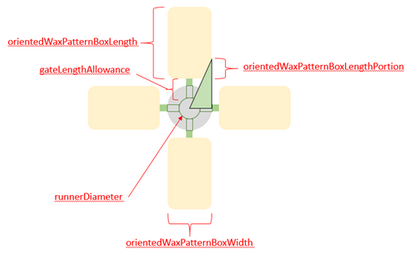
Users can override the default (for either tree type) with the setup option Number of Wax Patterns per Layer.
Number of Tree Layers
By default, the number of wax patterns along the height dimension of a tree (that is, the number of layers of patterns in the tree) is the maximum number of wax patterns that can fit along the maximum height dimension (see Tree Bounding Box Maximum Height). This is determined based on the following assumptions:
-
Wax patterns (if more than one fits along the height dimension) are separated by a spacing allowance; see Wax Pattern Spacing Allowance.
-
The distance along the tree height occupied by each wax pattern is the sum of the following:
-
Pattern dimension that is aligned with tree height; see Orientation of Wax Pattern in Tree.
-
Twice the value of the cost mode variable singleGateHeightAllowance (19.05mm in starting point Digital Factories), if the Gate Attach Location is top/bottom.
-
-
The distance along the tree height occupied by the primary runner is the value of the cost model variable runnerLengthAllowance (38.1mm in starting point Digital Factories).
Users can override the default with the setup option Number of Layers per Tree.